Research led by academics from Royal Holloway, has identified strong evidence of topological superconductivity, marking a significant advance in the search for materials that could create the hardware for next generation quantum computers.
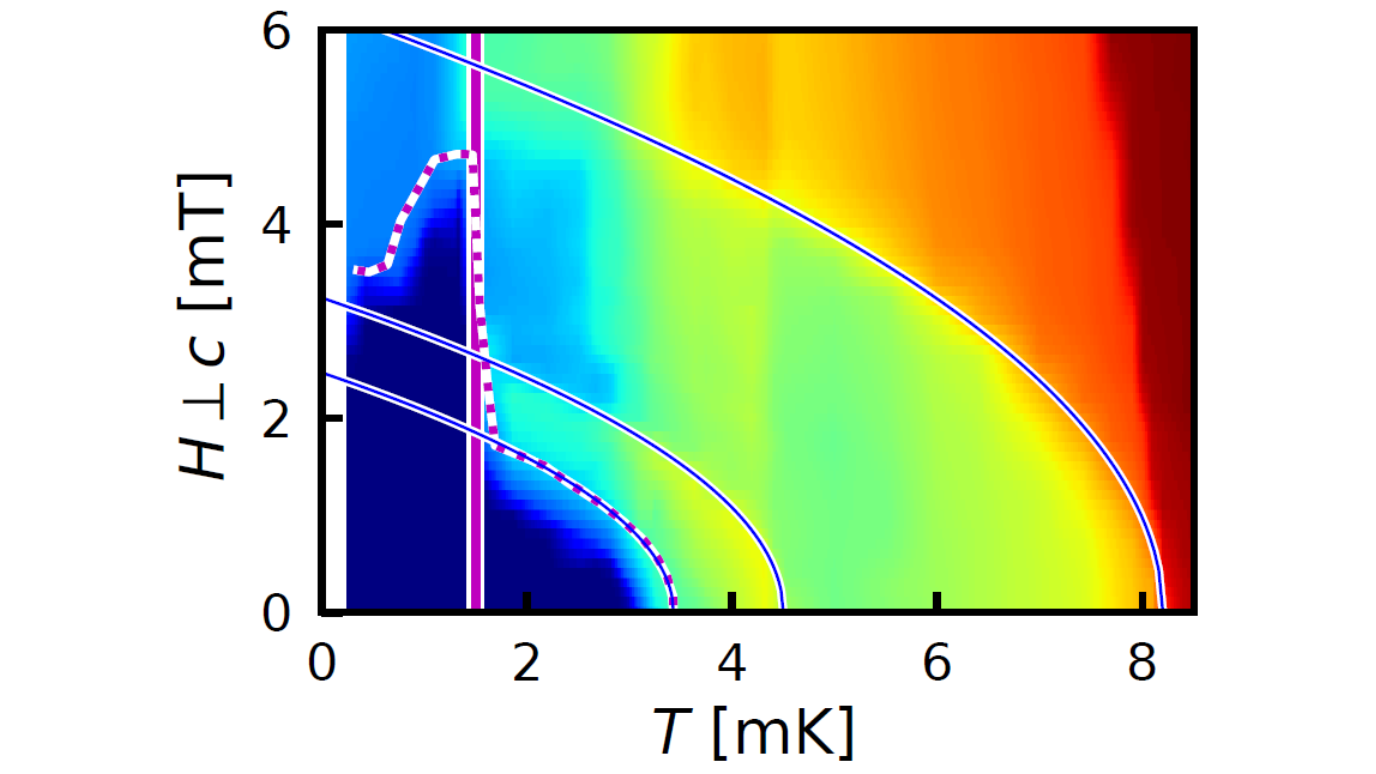
These findings, published in Nature Physics, found evidence of topological superconductivity by examining an intermetallic compound made from the elements ytterbium, rhodium and silicon.
The compound – chemical formula YbRh2Si2 – relied on crystals grown at the Goethe University, Frankfurt, Germany and characterised at the Max Planck Institute for Chemical Physics of Solids, Dresden, Germany, which were cooled to the low temperature frontier at the London Low Temperature Laboratory at Royal Holloway.
This collaboration was enabled by the European Microkelvin Platform, a consortium of 17 partner institutions focused on research in ultralow temperature environments, which includes Royal Holloway.
Quantum computers can perform calculations and solve problems exponentially faster than normal computers. At the heart of every quantum computer is a qubit. The performance of a quantum computer depends on how quickly these qubits can be manipulated, but even tiny, uncontrolled interactions with the surrounding environment can disrupt their quantum state and introduce errors. As governments and industry invest heavily in quantum computing, reducing error rates and engineering effective quantum error correction software strategies, are major priorities.
Topological superconductors are extremely rare, but they are considered to underpin one of the most promising hardware routes to building quantum computers capable of operating with dramatically reduced error rates. The discovery of such materials is becoming an increasingly important scientific priority. The research team at Royal Holloway’s London Low Temperature Laboratory set out to discover metals which themselves intrinsically act as topological superconductors at sufficiently low temperatures.
By using powerful new techniques at ultralow temperatures down to less than one thousandth of a degree above absolute zero, the researchers investigated the superconducting and magnetic behaviour of YbRh2Si2. Their measurements revealed an interesting interaction between superconductivity and a newly discovered low temperature magnetic phase, which provides compelling evidence for the topological superconducting properties they sought to find.
The work forms part of a wider international effort to identify materials that naturally host topological superconductivity. While topological quantum computers are currently pursued with devices fabricated from complex hybrid structures, the intrinsic topological superconductors could offer a more robust alternative.
Dr Lev Levitin, Senior Research Fellow at the Department of Physics at Royal Holloway, said: “The striking interplay between the superconductivity and magnetism arises from the rather unique magnetic properties of YbRh2Si2: ferro- and antiferromagnetic fluctuations, and electronic and electro-nuclear antiferromagnetic orders.
“So, our results give fresh insights into how odd-parity superconductivity may emerge from magnetic pairing interactions. There is a clear pathway to improve our understanding of this material, and potentially exploit it, using techniques such as focussed-ion-beam sample machining.”
Dr John Saunders, Professor of Low Temperature Physics at the Department of Physics at Royal Holloway, added: “While this topological superconductor is found at rather low temperatures, this temperature regime is nowadays far more easily accessible than one might think, potentially via commercial systems, and the techniques to measure are well established.
“Our work hugely benefitted from the opportunities provided by the European Microkelvin Platform, by its collaborative ethos, and flexibility to co-create projects with the best.”
The full paper, published in Nature Physics, can be read here.