Archives of Royal Holloway and Bedford College
This digital exhibition space provides access to the combined archival heritage of Royal Holloway and Bedford College. It serves as a scholarly and public resource for exploring the historical development of these institutions and their broader impact on social, political, and cultural history.
Through this platform, we present curated selections from our physical holdings, facilitating engagement with primary source materials that document a legacy of institutional growth and social contribution.
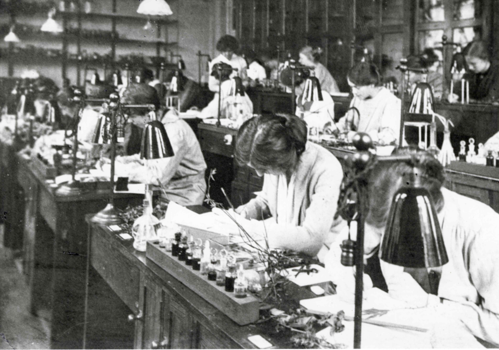
‘The Final year Botany class at work in the general laboratory’, Bedford College (1914), BC PH/4/4
Institutional Foundations
The history of both colleges is rooted in the 19th-century movement for educational reform. Bedford College was established in 1849 by Elizabeth Jesser Reid as the first institution in the United Kingdom to provide higher education for women. Similarly, Royal Holloway College was founded in 1886 by Thomas and Jane Holloway to expand these educational opportunities.
As historically significant women’s colleges, both institutions fostered an environment of academic rigour and social advocacy. This foundation informs our current role as a University of Sanctuary, reflecting a long-standing institutional commitment to providing a supportive environment for those excluded from or displaced within education.
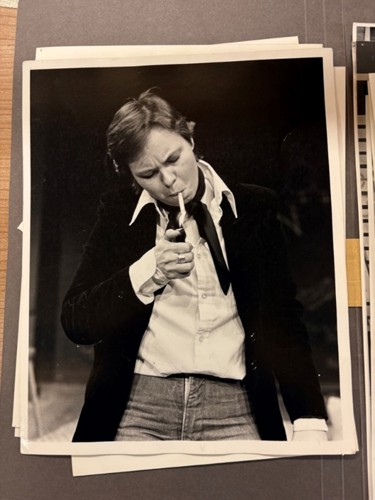
Gay Sweatshop Theatre, General Photographs (1990-1995), GS/6/1
Primary Collections
These collections represent the breadth of our archival remit, spanning institutional administrative records to significant specialized theatre and activist archives:
The Roy Waters Collection: A comprehensive archive of theatrical ephemera, playbills, and memorabilia. This collection offers a detailed record of the history of British performance and the evolution of the stage from the 18th century onwards.
Gay Sweatshop: The records of the UK’s most influential radical LGBTQ+ theatre company. These materials document the intersection of performance, queer visibility, and political activism during the late 20th century.
Audiovisual Collections: A comprehensive archive of recorded theatre productions, oral histories, and historic institutional film. This collection documents the administrative and student history of Royal Holloway and Bedford College, and includes archival footage of notable visits to the campuses.
The Shared Heritage Archive: Selected records tracing the parallel development of Royal Holloway and Bedford College. This collection includes photographs, administrative files, and student ephemera documenting campus life, institutional governance, and the colleges' roles in wider social movements.
Research and Engagement
This space is designed to support the "afterlife" of the archive, encouraging new research and critical re-examination of our holdings. By making these collections accessible online, we aim to support the academic community and the wider public in uncovering the narratives contained within our physical records.
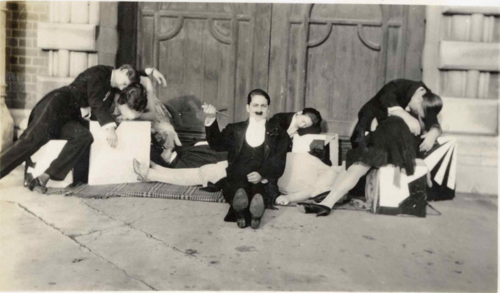
'Gentlemen of Soho', Photograph Album of Audrey Baddeley, Royal Holloway College (1928), RHC PH/385/10
If you have any questions or research requests, please email us at archives@rhul.ac.uk.
All images and content are subject to copyright.
Blogs
'Playing With Gender': Exploring Gender and Identity in the Context of Performance
A compilation of our favourite items from the archive exploring gender identity in theatre
Over the past four months, PhD candidates Charlotte Bookham and Jack Fairey have been undergoing a Doctoral placement in the Royal Holloway archives. As part of this placement, they have been mounting a mini exhibition, ‘Playing With Gender’, examining materials within the archive that explore gender identity in the context of performance. Here, they have detailed a few of the materials that have inspired them throughout the placement.
Jack on: Student Photo Albums
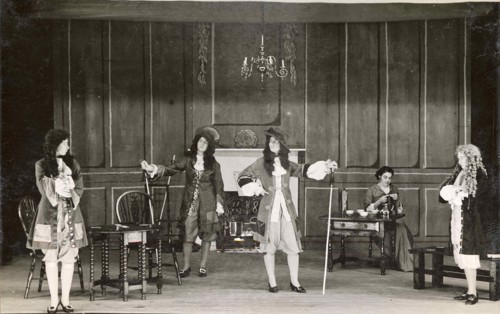
Among the Royal Holloway and Bedford College collections in the archive, there are numerous photograph albums donated by alumni. These paint a vivid snapshot of what life was like for students in the early years of both colleges. Class photographs, staged portraits of fellow students, and images of sports teams are abundant. But one of the most striking recurring themes is images of the students taking part in drama productions.
As well as offering an insight into the extra-curricular lives of England’s first women university students, they demonstrate an interesting reversal of traditional gender roles. In the early days of English theatre all roles were played by men, with women only taking the stage after a royal decree in 1662. In these photo albums, however, this gender imbalance is reversed. Due to the all-women make up of the student body, these productions were performed with an all-women cast.
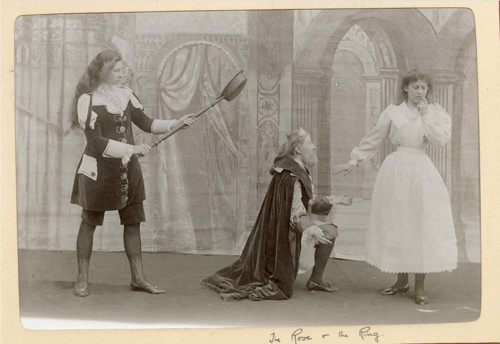
There is no apparent intentional revolution in this act. The students at Bedford and Royal Holloway were educated, interested young women. As seen in the albums, they wanted to immerse themselves in a wide breadth of activities - languages, sciences, sports, and drama. The only way they could perform these plays was by gender swapping, and so they did. By doing so, not only did they challenge and subvert an activity that had traditionally been denied to them, they also revealed the masculine dominance of the English theatrical cannon. In many of the pictures, the cross-cast male characters outnumber the women, showing how man-centric English theatre was - and, arguably, still is.
This is just one of the many insights provided by these albums into the lives of female students, and the part they played in the upheaval of traditional gender roles and move towards women’s suffrage.
Charlotte on: Clo Graves
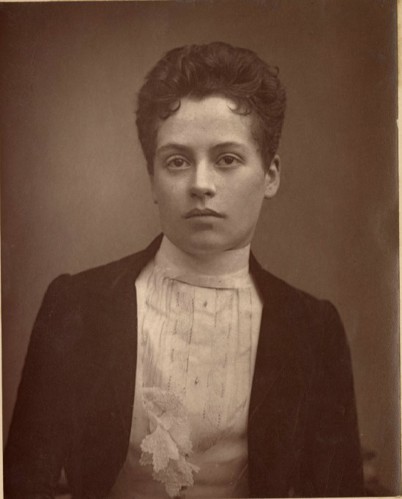
Throughout this project we found examples of fascinating individuals who played with gender professionally and personally. For me, the figure who stood out most was Clo Graves. While I was familiar with Edwardian male impersonation from my own research into travelling theatre and variety, Clo’s portrait struck me as very unusual.
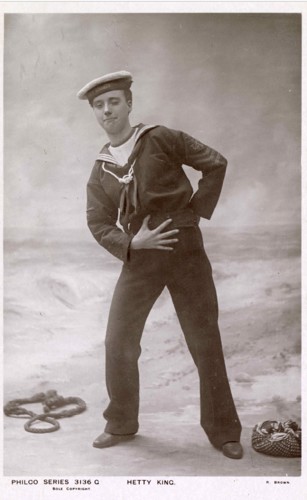
Unlike Hetty King or Vesta Tilley, Clo Graves was not a “male impersonator”. Clo was a playwright, journalist, artist and author of Irish descent who produced successful works in London and New York City. In nineteenth-century London, Clo’s behaviour made her stand out. She presented as more masculine, cutting her hair short, smoking in public and dressing in more masculine attire. She also preferred the name “Clo” to the more feminine Clotille, going by this name or her novel penname Richard Dehan. At this time, the language for non-binary or trans identities did not exist in the way we understand them now. This, however, did not mean that Clo was not part of this history. Kit Heyam’s Before We Were Trans (2022) encourages historians to look for people who did not fit into ‘modern and/or Western trans categories’. Including Clo’s portrait in the exhibition, together with the work of our student and alumni interpreters was crucial in emphasising that gender has never been a fixed category.
How this captivating portrait made its way to our collection is less clear. As a part of the Roy Waters Theatre Collection at Royal Holloway, the image would have been purchased by the collector Roy Waters, likely at an auction. His collection spans continents and time periods, all tied together by his love of the theatre. Clo’s portrait can remind us of the ubiquity of gender nonconformity in the past and today, or, for some of our student interpreters, it served as an unexpected moment of recognition.
As one student commented, the objects we found showed them that ‘we’re not some “new thing”’. And, really, you can’t get better than that.
References:
RHC PH285/3 (Photograph Album donated by Margaret Hodge)
RHC PH285/4 (Photograph Album donated by Margeret Yates)
RHC PH 285/6/5 (Photograph Album donated by Miss Frost)
BC PH/6/2/2/4 (Bedford College Unidentified Greek Drama, 1890s)
RW/14/2/7 (Portrait of Clo Graves)