Dr Sai Chaitanya Susarla
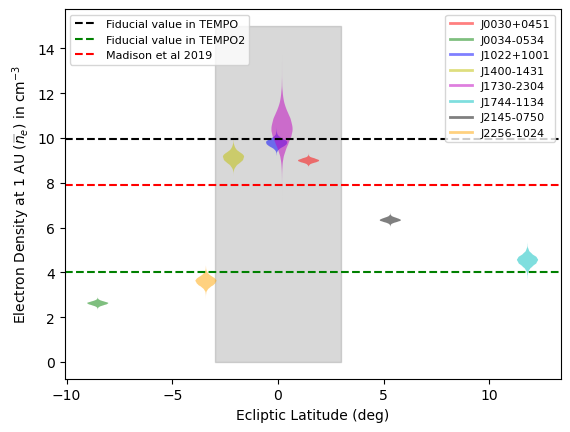
Pulsars are highly stable cosmic clocks whose precise timing enables a wide range of astrophysical studies, including the detection of nanohertz gravitational waves using pulsar timing arrays (PTAs). In this talk, I focus on a major propagation effect that strongly impacts pulsar timing, particularly at low radio frequencies: the solar wind. Temporal variations in the solar wind electron density introduce dispersive delays in pulsar signals which, if not modelled accurately, can mimic or bias low-frequency signals relevant for gravitational-wave searches. I will present SWGP, a novel Bayesian framework that treats the solar wind as a stochastic noise process in pulsar time-of-arrival data. Using low-frequency LOFAR observations, we directly infer line-of-sight electron density variations and validate these estimates through comparisons with independent space-probe measurements. We further improve the solar wind noise model by exploiting its bimodal structure, explicitly separating slow and fast wind components to directly infer solar wind properties from the data and obtain tighter constraints on the SWGP model parameters. This physically motivated approach outperforms existing solar wind correction methods and leads to improved noise characterization in PTA datasets. SWGP is now integrated into PTA noise analysis pipelines, strengthening the robustness of low-frequency gravitational-wave searches.